
Home
A key to conquer the (open source) world.

Main navigation

  • Home
  • About Us
    • About this website
    • About_me
    • Family rivalry
  • Gurus
  • Tutorials
User account menu
  • Log in

Breadcrumb

  1. Home

🔋Why Not All AA Batteries Are Created Equal

Hero image for keyhole tutorials.

AA batteries—demystified.

Those tiny letters on AA batteries aren’t random—they’re the key to choosing the right one. Once you know what the codes mean, picking the best battery becomes effortless. This quick guide breaks down the markings that reveal the chemistry and performance behind every AA.
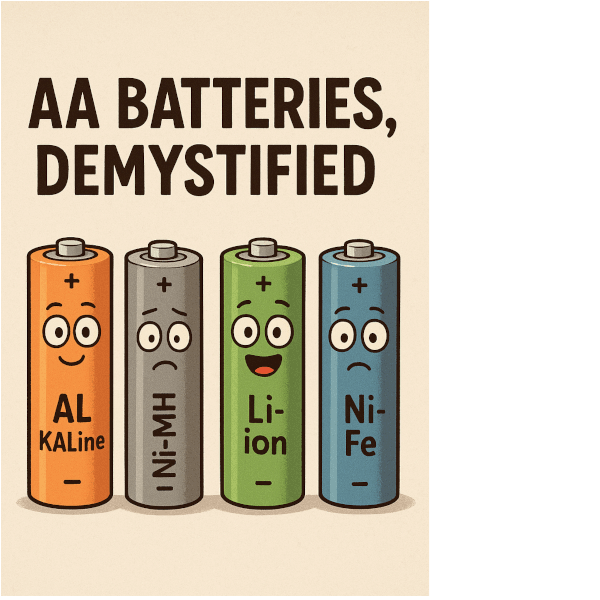
AA batteries demystified.

AA Batteries: What Makes One Better Than Another?

The markings on AA batteries may look confusing, but they’re actually the secret to understanding how well a battery will perform. To know what you’re really buying, you just need to recognize a few simple codes.

LR6 and R6 aren’t interchangeable, and labels like LR6-BP4 or R6P AA UM-3 aren’t random—they reveal the battery’s chemistry, quality, and real-world performance.

The Real Meaning Behind AA Battery Codes.

Ever spotted an AA battery labeled R6P AA UM-3 and wondered what all those letters mean? Here’s the breakdown:

  • R – Round (cylindrical) cell.
  • 6 – AA size code.
  • P – “Power” or general-purpose zinc-carbon (the cheap kind).
  • AA – Retail name for the size.
  • UM-3 – Japanese JIS code for AA.

It may look confusing, but the secret is simple: it’s all about the chemistry. AA batteries come in several types—and they don’t all perform the same. Once you understand the codes, you instantly know what you’re buying. Learn the chemistry behind each code, and choosing the right AA battery becomes effortless—and your devices will run noticeably better.

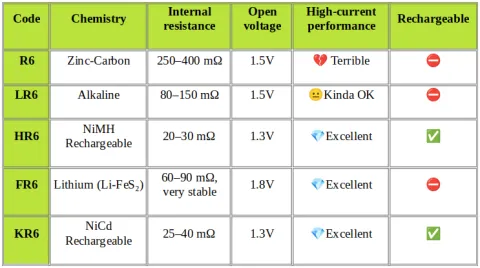
A quick breakdown of the codes:

Image
Breakdown of the AA codes.

Conclusion:

  • R6 — Zinc-Carbon: High internal resistance and weak high-current performance. Cheap, but best suited only for remotes and clocks.
  • LR6 — Alkaline: Lower internal resistance and better output, but still struggles with power-hungry devices like cameras and flashes.
  • HR6 — NiMH Rechargeable: Very low internal resistance and excellent high-current performance. Ideal for cameras, flashes, and anything demanding—plus fully rechargeable.
  • FR6 — Lithium (Li-FeS₂): High capacity, stable voltage, low internal resistance, and excellent performance under heavy loads. The best non-rechargeable option for high-drain devices.
  • KR6 — NiCd Rechargeable: Strong performance and low internal resistance, though older chemistry. Still excellent for high-drain use cases.

High-Current Devices Like Cameras Need the Right Batteries—Here’s Why R6 and LR6 Fall Short.

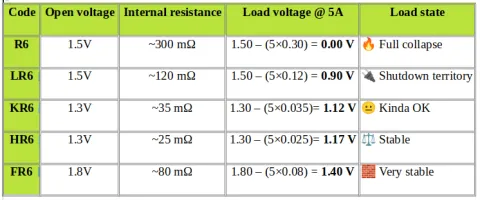
Cameras, flashes, and game controllers pull a lot of power. Alkaline LR6 batteries might turn them on, but the moment you fire the flash or hit auto-focus, they often shut down. The batteries aren’t dead—they still run low-drain devices like a mouse just fine. The problem is simple: high current plus high internal resistance drops the output voltage below what your device needs.

And if that sounds technical, a quick 5-amp flash-recharge example makes it crystal clear:

Image
Calculation example.

Cheap batteries don’t actually save you money—your device just won’t perform the way it should. Cameras run far better on NiMH (HR6) or lithium (FR6) cells. R6 zinc-carbon batteries, meanwhile, are only good for low-drain gadgets like wall clocks.

Note: The same standards and guidelines apply equally to AAA batteries.

Quick Tips to Make Sure Your Batteries Are the Right Fit.

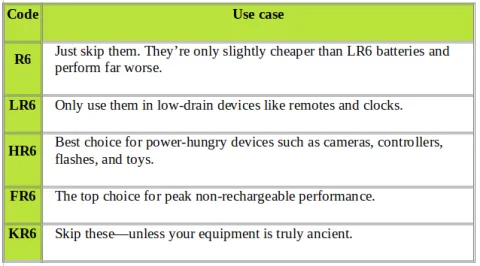
Ignore the flashy “Heavy Duty” labels—focus on the tiny code instead.

When you’re buying AA batteries, focus on the device you’ll use them in. Marketing terms like ‘Heavy Duty’ don’t mean much. The real information is in the small codes and numbers printed on the battery—they reveal the actual chemistry and performance you’re getting.

Image
Quick Tips.

Tip: 
Some brands add icons to hint at what their batteries are made for. A clock usually means zinc-carbon (R6), a flashlight suggests alkaline (LR6), and a camera icon often signals lithium (FR6). The icons aren’t standardized, but they make it easy to spot low-quality options at a glance.

For cameras and other high-drain devices, NiMH and FR6 (lithium) AA batteries are the clear winners. NiMH has the bonus of being rechargeable, making it the most cost-effective choice over time. Just make sure you’re using a quality charger—one that handles both AA and AAA without trouble.

Using a charger? Always check the label first. Only a true smart charger—with temperature monitoring, delta-V detection, or safe trickle mode—can safely handle NiMH batteries. Leaving them in a basic charger overnight can overheat them, shorten their life, or even damage the casing.

Modern rechargeable batteries hate being fully drained. Running them down to 1% before charging is a bad idea—regularly hitting zero shortens their lifespan. NiMH cells last longest when kept between roughly 20% and 80% charge.

FR6 lithium batteries are ideal for cameras. With high capacity and very low internal resistance, they handle heavy current bursts effortlessly. They aren’t rechargeable, but a single pack typically lasts a long time in most cameras.

Warning: 
Quick Tip for Buying Lithium AAs: Always Check the Voltage! Most lithium cells on the market are 3.7V—not 1.5V—and use a completely different chemistry. Putting them in your camera is a recipe for disaster. For cameras, stick to 1.5V lithium primaries, like the Energizer Ultimate Lithium series. And remember: if it’s rechargeable, it’s the wrong chemistry for AA devices—only non-rechargeable lithium AAs are safe replacements.

This Tutorial Made Me See AA Batteries in a Whole New Light.

I killed so many R6 AAs, I lost count—Turns out the problem was me, not the batteries.

Back to the tutorial list.

Author.

Categories
Environment
Open source News
Mon, 11/24/2025 - 16:49

Managed ad1

RSS feed
Powered by Drupal